





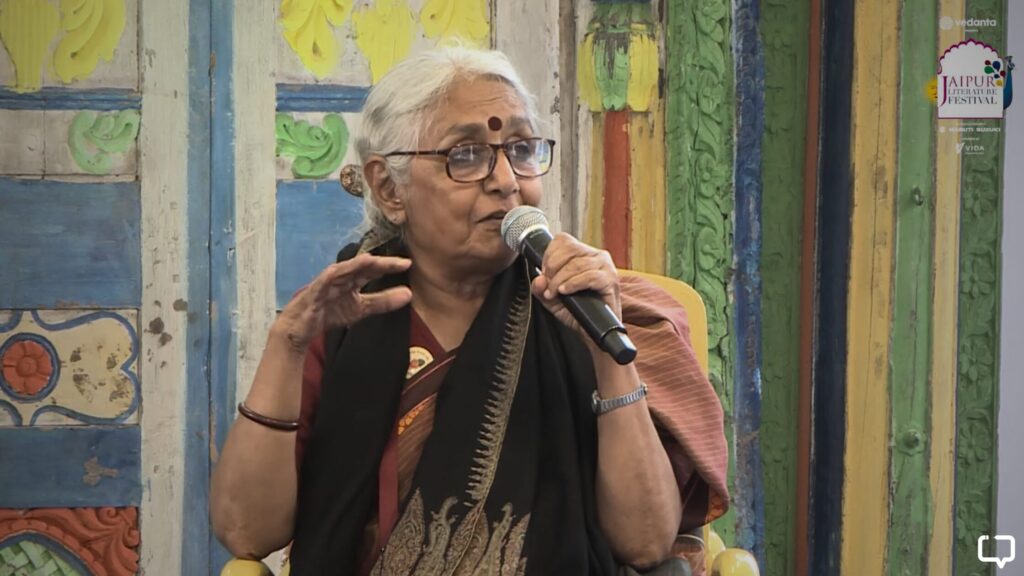
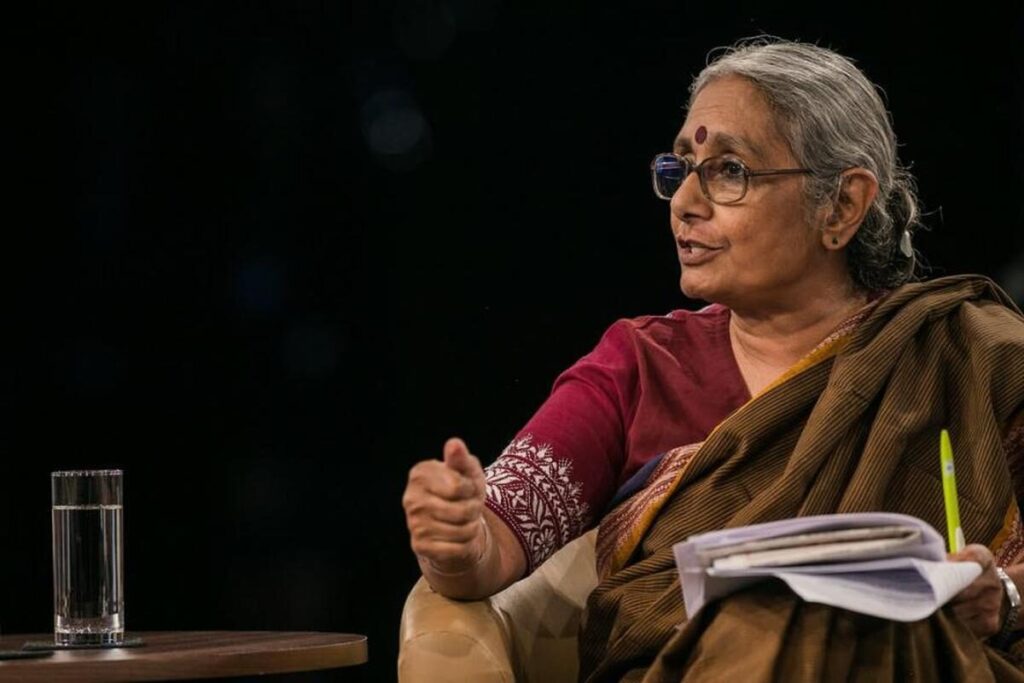
Amritesh Mukherjee from Team P3 was in conversation with Aruna Roy at the Jaipur Literature Festival, 2025.
The personal is political. It’s a statement we’ve oft heard, you and I, but what does it truly mean? Does it simply mean posting about a sociopolitical injustice from the comfort of our homes, air-conditioned air blasting away the poverty around us, sipping coffee, tapping away on our expensive gadgets, and calling it a day? Does our personal sense of justice and injustice even matter if we don’t act on them? If we don’t consciously and actively try to make the world a better place? If we don’t stand up for our rights and the rights of our fellow less fortunate brethren?
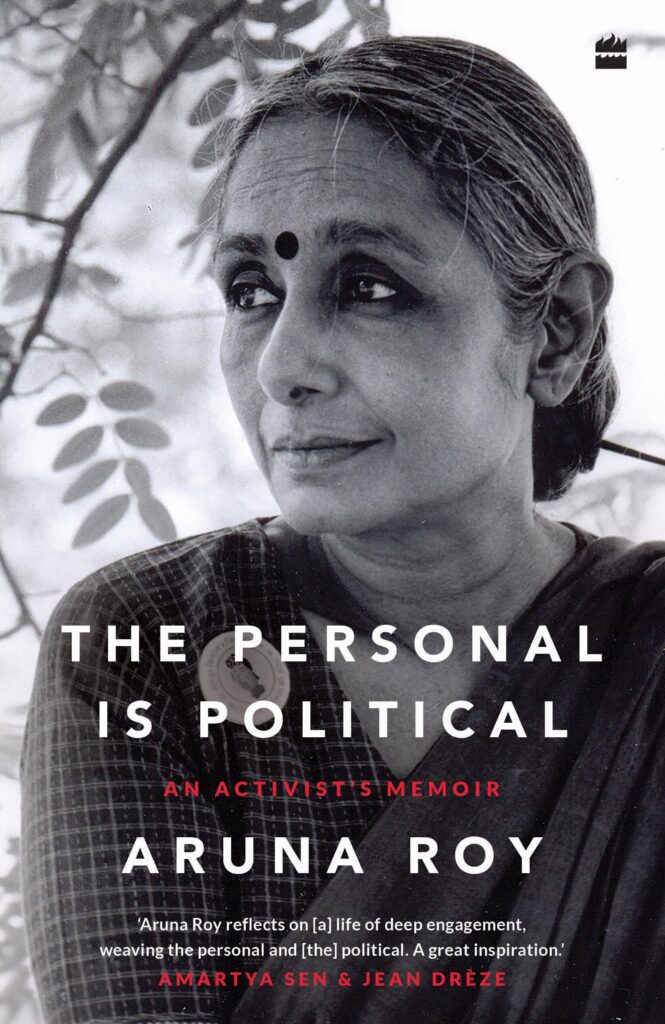
Providing the roadmap for a life in transfiguring your personal beliefs into political action is Aruna Roy’s memoir, The Personal is Political. It charts a life spent amidst the people, for the people, a life that has loftily aimed for and brought much change. I sat down with Aruna Roy at the JLF earlier this year for an inspiring conversation, during which she graciously answered all my questions despite the limited time we had. Edited excerpts:
In Conversation With Aruna Roy
Amritesh Mukherjee: Can you elaborate on the journey of your memoir? Was it something you started with a clear aim, or did it evolve as you were writing?
Aruna Roy: I’m a believer in communication because every activist is a communicator. I’ve always believed in the spoken word, and that’s been my power, where you relate eye to eye, face to face. But then I realized that we are limited by the scope of our travel, where we can go and where we can’t go. So those of us who can write should also write.
When you write, you don’t know who it will reach. That uncertainty is frightening. But you tie your courage to your waist and carry on.
Aruna Roy
My first attempt was to write the RTI story, how it came to be. I thought the story had to be there, of how ordinary people created the RTI. So when I wrote this book, I wanted to be in conversation with people. I wanted to say to them, “Look, everything is not good. Even those of us who are seen as very successful, there are brave moments, there are bad moments, and nothing is ever neat in life. There are issues we yet need to change, we yet need to think of things. Not everything needs to be packaged and answered.”
Recommended Reading: “I am amazed at how writers always step up to their time.”: Nilanjana Roy
To accept that there can be grey areas, that they can be questioned without answers, is the basis of a journey, a quest. I will leave something incomplete, and many others will have to join the journey and complete those questions and worries, maybe take a completely different position on them.
So how else do you give it except to write? It’s very difficult because when I’m talking to you, I know what you’re thinking and feeling. But when you write, you don’t know who it’s going to reach. So there was a worry as to what would happen when this book reached people. But I had to tie my courage to my waist and carry on.
That’s how the book came to be. Every activist wants to communicate and talk to people about issues, so it’s a continuation in black and white.
Amritesh: Standing on the shoulders of giants, as Einstein says.
Aruna Roy: Yes. The giants are the people of India.
Amritesh: As a journalist, the growing apathy of the world worries me, as we have seen in Palestine. How do you deal with that growing apathy?
Aruna Roy: I think one thing we have to understand is that we have to break these things into their component parts. When we see it as a whole, it’s impossible to bite it. We have to dismantle it, unpack it. Then, piece by piece, you understand what it is that you can do to destroy that.
Every activist is a communicator. I’ve always believed in the spoken word, in relating eye to eye, face to face—but writing became necessary when I realised how limited our reach really is.
Aruna Roy
If you see it as a monolith, it’s impossible. I see it and I think, what can I do? Therefore, the right information, everything, was breaking it into its component parts. Aruna Roy began with what? Asking to see records about wage employment in a village. How would you ever say that it was related to the Right to Information? But that was the root of that big major question. That’s how one should work.
Amritesh: Activism has not always been positively received in society, and that has changed for the worse in the last few years. How has your experience been in that regard?
Aruna Roy: When I left the IAS, they used to say, “You’ve sacrificed, so we will put you on a pedestal.” You’re sacred. I said, no, I haven’t sacrificed. From being halfway to sainthood, we’ve slipped down and become urban Naxals now.
This feeding of the common imagination is a strategy of people in political struggle who want to undermine the democratic voice. The reason they’re calling us urban Naxals is that people’s movements have become very powerful in this country. In Europe and South America, many people commented on how powerful Indian social movements were. It’s the power of these social movements they want to annihilate, and that’s why all this is happening.
Amritesh: Can you recommend some books that have shaped you and that you think are important for people to be better citizens?
Aruna Roy: I read to enjoy myself. Nowadays, I’m reading M. N. Roy’s Radical Humanism. He talks about how humanism is a value. He was a communist, but he differed in the sense that there must be humanism. If you leave the human contact and touch, what’s the point of equality?
From being seen as halfway to sainthood, activists are now called urban Naxals. This is a strategy—to undermine democratic voices because people’s movements have become powerful.
Aruna Roy
He was a great man, and I’m rereading him because I need to think again. At the same time, I’m also reading Jenny Erpenbeck’s diaries. I finished her book and I’m excited about realigning the information I have about Germany and the bifurcation of Germany.
I read Wodehouse. I read detective novels written by women. I read humour. I read everything. I read Gandhi, I read Ambedkar, I read Marx, and I read philosophers. I read Krishnamurti. These are my serious readings. I also do a lot of light reading. I read a lot of literature because I’m a student of literature. I reread D. H. Lawrence, Jane Austen, Virginia Woolf. I enjoy active reading, and it’s been very important to keep my balance.
Amritesh: Thank you so much.