





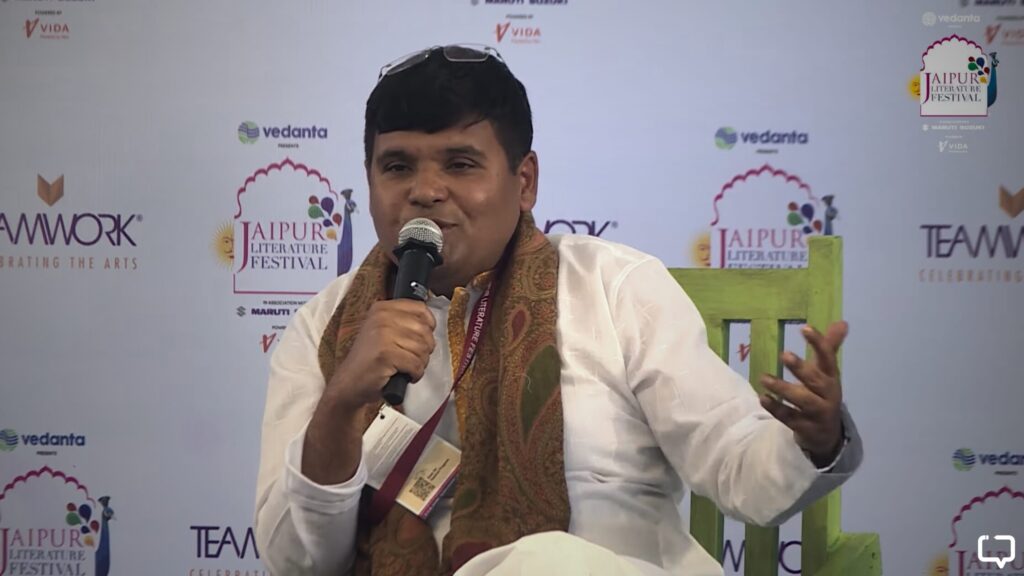
Amritesh Mukherjee from Team P3 was in conversation with Arghya Sengupta at the Jaipur Literature Festival, 2025.
Are we citizens or are we subjects? Did we break the shackles of our Colonial past or just inherited that dark legacy? Arghya Sengupta, through his book The Colonial Constitution: An Origin Story, questions that foundational text of the Indian republic. An immensely readable and certainly thought-provoking book, it’s also a continuation of his work at the Vidhi Centre. I sat down with the author at the JLF earlier this year for a candid conversation, where we discussed his book, Ambedkar, the varying attitudes towards the Constitution, and the relationship between the state and its supposed citizens. Edited excerpts follow:
In Conversation With Arghya Sengupta
Amritesh Mukherjee: How has your experience at the JLF been so far?
Arghya Sengupta: It’s been a wonderful experience. This is the first time I’ve written a book that brought me to JLF. It’s lovely to see such love for literature and ideas. The way JLF has democratized not only itself but also the reading and love of books is wonderful.
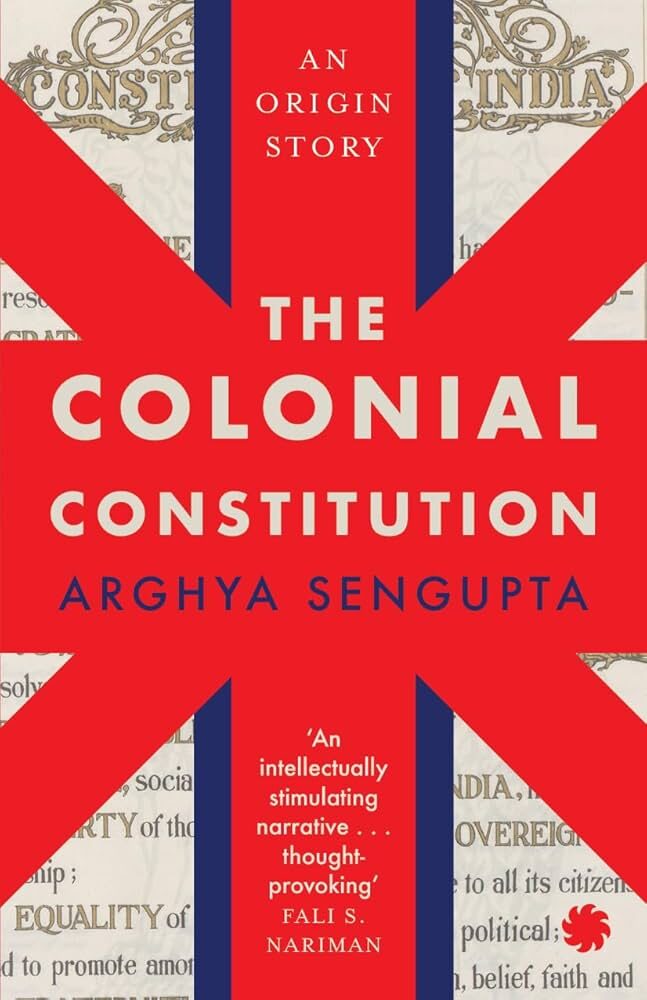
Amritesh: Let’s talk about your book. There are two binaries when it comes to the Constitution—something you addressed in your book and in the discussion. One side shows a kind of blind devotion to it, which intensifies as pressure mounts from the other side. The other side wants to replace it with something worse. Your book doesn’t sit with either camp. Was that intentional?
Arghya Sengupta: Yes, that was a very intentional choice. Someone jokingly said, “One side will love the cover and hate the content, the other will hate the cover but like the content if they read it.” In this polarized age of social media, breaking down binaries is important. Like any large document, the Constitution has sections that are wonderful: ideas around equality and religious harmony are essential and must be preserved. At the same time, there are problematic elements: emergency powers, preventive detention. These are colonial relics, and we need honest conversations around them.
When migrants were sprayed with disinfectant, it showed how far our constitutional values of dignity and liberty still have to travel. ‘We the People’ were treated as subjects, not citizens.
Arghya Sengupta
The problem today is that any critique of the Constitution is seen as an attack on it. That does a disservice to Babasaheb Ambedkar. He didn’t want to be deified. If you read his work, you see a real intellectual who thrives on engagement, disagreement, and debate. So we need to engage with the Constitution, not in black-and-white terms.

Look at the recent parliamentary debate on the Constitution. I was happy it happened. Credit to Rahul Gandhi for putting the Constitution front and centre during the general elections. But during the debate, every political party was trying to claim ownership of the Constitution. No one discussed how to make it work for the ordinary citizen in 21st-century India. How do we ensure its values help people escape poverty, or guarantee peace and stability? These are the questions we should be asking. That’s what my book tries to do.
Amritesh: You write about how Ambedkar, as chair of the Drafting Committee, had the final word. But later, he tore into the Constitution and rejected many of its provisions. What changed?
Arghya Sengupta: With a real intellectual like Ambedkar, there are always strands in their thinking; it’s not black or white. The Constitution, as I wrote in the book, was a collective effort. I used a cricketing analogy: Ambedkar was like the captain who came in at number four and played a solid innings. But there were others. B.N. Rau was the opening batsman who traveled globally to gather constitutional ideas. Rajendra Prasad, as president of the Constituent Assembly, ensured it functioned consensually. Many others contributed.
Every political party claims ownership of the Constitution. But no one asks how it can actually work for the ordinary citizen in 21st-century India.
Arghya Sengupta
Ambedkar was the final authority during debates. Whatever he said became part of the text. But we must remember it was a collective effort. Just because he played a central role doesn’t mean he agreed with every word. Later, after resigning as Law Minister due to differences with Nehru’s cabinet, he was disappointed by the first amendment curbing free speech, by the state’s stance on civil liberties and directive principles. By the early 1950s, Ambedkar’s thinking had shifted. He became more Gandhian, moving into the moral realm. His deeksha into Buddhism was a powerful personal act outside the legal framework. That’s where he saw the future.
This is why criticisms of the Constitution shouldn’t be equated with criticisms of Ambedkar. That point is vital. When the Home Minister repeatedly invoked Ambedkar in Parliament, people criticized the tone. But anyone should be able to comment on Ambedkar without it being seen as an attack on a minority community. We must engage with his ideas critically. He wasn’t a deity. He was a visionary.
Amritesh: It feels like people treat the Constitution and Ambedkar’s writings the same way—as sacred, beyond critique. But I understand where it comes from.
Arghya Sengupta: We must be conscious that we are upper-caste Hindu men. We can see Ambedkar as an intellectual, but for Dalits, he is much more. I respect that sentiment. Go to Chaitya Bhoomi in Mumbai on December 6; it looks like a temple. People queue like they would at Tirupati. That feeling is real, and I respect it.
But when reading his writings, we shouldn’t venerate them as if they’re religious texts. I grew up reading Ramakrishna Mission and Swami Vivekananda. I deeply respect Vivekananda, but I still critique his writings, especially his views on India and on women. That doesn’t take away my reverence. We need to find balance in our worship.
Amritesh: You mentioned a scene in your book from 2020: migrant workers sprayed with disinfectant. You used it to represent how the state stands over citizens. Was that part of your conscious writing process? Did you want to make the Constitution accessible to everyone?
Arghya Sengupta: Absolutely. I didn’t want this book to be read only by lawyers. When people think of the Constitution, they assume it’s for lawyers. Even the blurbs on the back of the book are from law professors and judges; I didn’t control that. But the Constitution belongs to every citizen.
That scene you mentioned—migrants being sprayed—was a key moment for me. It happened near Bareilly, Uttar Pradesh. Migrants were returning home and state agents were spraying them with chemical disinfectant. That image, for me, captured everything wrong: citizens, who are “We the People,” sat with folded hands while the state, meant to serve, sprayed them like pests.
Criticizing the Constitution is not the same as criticizing Ambedkar. He didn’t want to be deified—he thrived on disagreement, debate, and intellectual engagement.
Arghya Sengupta
This wasn’t about COVID alone. It was about what we accept as a society. It showed how far our constitutional values of dignity, liberty, and life have yet to reach. That’s why I wrote the book. That’s why it has a provocative title—to spark discussion. Some think it’s a right-wing book, and won’t even pick it up. That’s their right. But we need a public debate on the Constitution.
Amritesh: India is a deeply god-believing country, as a Pew study also showed. Do you think our veneration of the Constitution stems from that religiosity? Is this veneration unique to India?
Arghya Sengupta: No, it’s not. I’m against the cult of constitutional veneration because I’ve seen what happens in the U.S., arguably the origin of constitutional worship. There, people plaster it on car bumpers, quote it to justify gun rights. But while they revere the Constitution in theory, they violate its spirit daily.
Saurabh disagreed in the session; he said it should be holy. I’m okay with that, but only if we can interpret it freely. For that, we need engagement.
Recommended Reading: “Kohinoor is just a stone. There are priceless murties I’m more worried about”
Another criticism: why is the Constitution written in such difficult English? Why aren’t versions available in Bodo, Maithili, languages recognized in the Eighth Schedule? If someone wants to read it, how will they? That’s why my colleagues and I at the Vidhi Centre are working on a citizen’s constitutional handbook. If the current Constitution is of India, hopefully ours will be for India.
Amritesh: Beyond the Vidhi handbook, how else can we make the Constitution accessible? Most people won’t read more than two pages.
Arghya Sengupta: You’re right. The Constitution isn’t something you read like a novel. But there are things we can do. First, public reading of the Preamble; that’s a great start. It’s powerful and easy to grasp.
Second, make civics education better. Our NCERT textbooks were dry. Civics can be more engaging. Books like The Children’s Constitution of India are doing that.
Third, use multimedia: social media, video, podcasts. Shyam Benegal’s Sambidhan was a fantastic series on the Constitution’s making. We need more of that, in multiple languages. The Constitution must be available in all 22 scheduled languages.
Amritesh: Now a historical “what if.” You wrote about the Constitution of the Hindustan Free State. It reads like a wish list. If the Hindu Mahasabha’s vision had prevailed, would we have seen Savarkar’s Hindu Rashtra?
Arghya Sengupta: No, I don’t think so. Interestingly, the Hindu Mahasabha’s constitutional vision mirrors India’s current Constitution. They included three major elements: no discrimination based on religion, no state religion, and equal laws for all.
In this polarized age, breaking down binaries is essential. The Constitution has ideas that must be preserved, and provisions that must be questioned. Engagement, not blind devotion, is what keeps it alive.
Arghya Sengupta
That’s fundamentally similar to what we have now. Savarkar may have championed a Hindu Rashtra, but the Mahasabha’s draft effectively closed that door by declaring no state religion. So their constitutional vision doesn’t support a Hindu state. Even today, the BJP leads constitutional debates. They called Emergency Day “Sambidhan Hatya Diwas.” Publicly, they uphold constitutional values. Their battles are in society and politics, not law.
So would things have changed if the Mahasabha led the freedom movement instead of Gandhi’s Congress? Absolutely. But the document itself? Likely not.
Amritesh: Final question. What books helped shape your thinking on the Constitution?
Arghya Sengupta: The Working of the Constitution of India by Granville Austin is excellent. From the U.S., The Nine by Jeffrey Toobin shows how their Supreme Court interprets constitutional values. Tripurdaman Singh’s Sixteen Stormy Days about the First Amendment is also insightful.
And I’ll recommend a film: Hirok Rajar Deshe by Satyajit Ray. It’s framed as a children’s film but is really a powerful satire on authoritarianism and people’s power. Every adult should watch it.
Amritesh: Thank you.